
Spring TX Clay Soil and Concrete Foundations: What You Need to Know
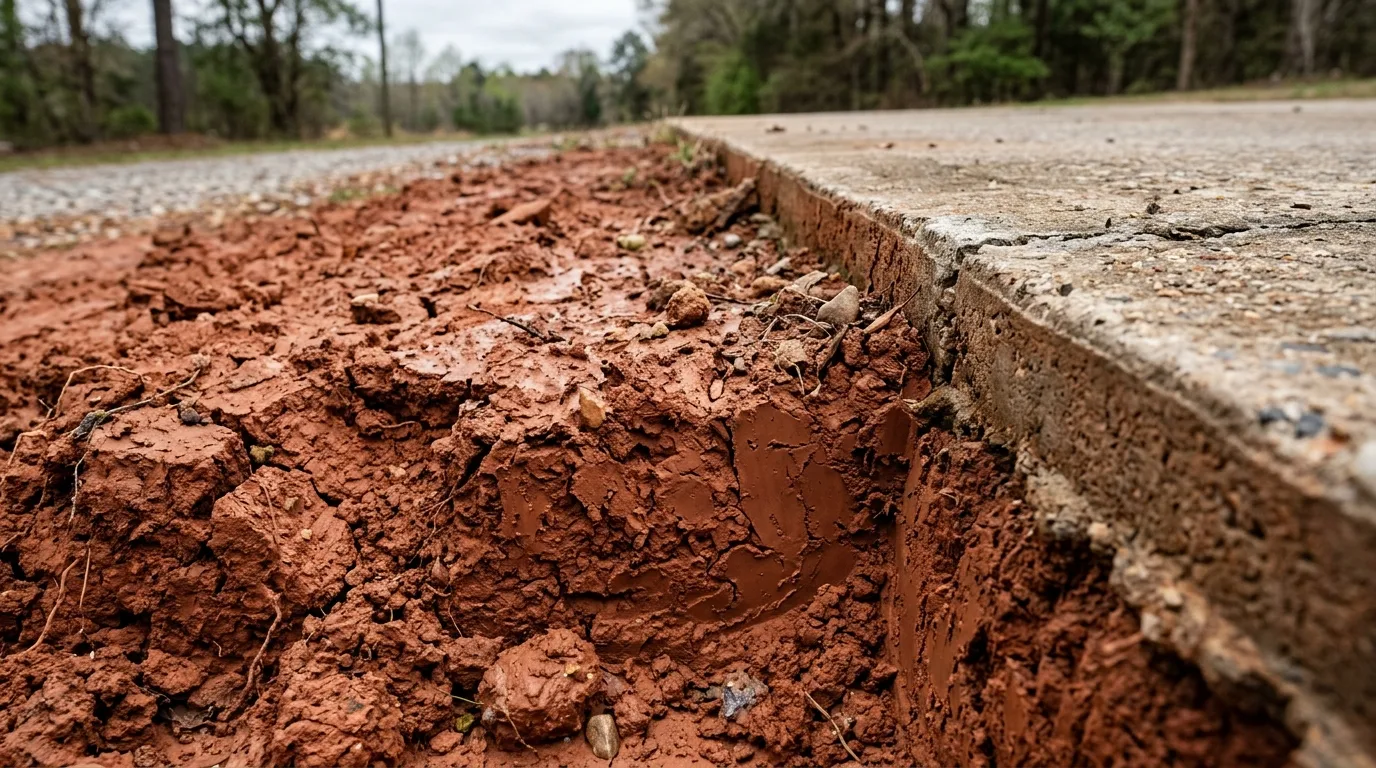
Every spring, homeowners across Spring, TX discover new cracks in their driveways, shifting foundation slabs, and sticking doors that weren’t a problem last fall. The culprit isn’t bad luck or poor construction necessarily — it’s the same expansive Beaumont clay soil that underlies most of Harris County, doing exactly what it does every year in response to seasonal moisture changes.
In this post, we cover: what makes Spring’s clay so problematic, how the shrink-swell cycle damages concrete, what lime stabilization actually does, and which Spring neighborhoods face the highest risk.
Concerned About Clay Soil Under Your Spring Concrete?
Spring Concrete Pros assesses subgrade conditions before every pour and recommends stabilization when needed. Call (888) 376-0955 for a free evaluation.
Why Spring, TX Clay Soil Is Different
Not all clay soils behave the same way. The Beaumont and Lake Charles clay series soils that dominate Harris County — including the Spring area — are classified as Vertisols, the same soil order that causes the famous “black cotton soil” problems in parts of Africa and the Midwest. What makes them unusual is their plasticity index: their tendency to absorb and release water, swelling and shrinking dramatically with moisture changes.
When Spring averages about 50 inches of annual rainfall concentrated in spring and early fall, and then experiences significant summer drought, the soil moisture variation across the year is substantial. A clay soil with a high plasticity index doesn’t just absorb extra water passively — it physically expands, pushing upward against anything resting on it. When that moisture leaves, the soil contracts and pulls away, leaving voids beneath concrete slabs, foundation edges, and driveways.
The key statistic that matters for concrete: these soils can change volume by 10–15% between wet and dry conditions. For a 6-inch-thick clay layer beneath a concrete slab, that’s potentially ¾ inch of vertical movement — more than enough to crack even well-reinforced concrete.
The Shrink-Swell Cycle and Concrete Damage
Understanding the seasonal cycle helps explain the timing of concrete problems in Spring, TX. In homes and properties throughout Gleannloch Farms, Spring Trails, and Benders Landing, the pattern repeats reliably:
Wet season (spring and early fall): Rainfall saturates the clay subgrade. The clay expands, pushing upward against the underside of slabs and driveway panels. If the expansion is uniform, the slab rides up together. If it’s uneven — one area near a downspout getting more water, another area under a covered porch staying drier — sections move at different rates. Differential expansion cracks slabs at control joints or in random locations where the stress concentrates.
Summer drought: The upper clay layer loses moisture rapidly in 95°F+ heat. The soil contracts, pulling away from the slab edge and creating voids beneath the interior. Sections that were pushed up now have no support, and vehicle loads cause them to break and settle. The void fills with debris, the section stays low, and a step forms at the joint.
Cycle repeats: Each year the movement accumulates. A crack that starts at ⅛ inch wide can reach ½ inch over 5–7 cycles. Water enters the crack, accelerates subbase erosion, and what started as a hairline crack becomes a structural failure.
Lime Stabilization: The Standard Solution
The concrete industry’s standard response to expansive clay subgrades is lime stabilization — the process of treating the native clay chemically before placing base material and concrete above it.
Hydrated lime (calcium hydroxide) is spread over the excavated subgrade and mechanically tilled to a depth of 6–8 inches. The lime reacts with the clay particles in a process called pozzolanic reaction: calcium ions from the lime displace the sodium and potassium ions that make clay particles swell, reducing the clay’s plasticity index. The reaction requires 24–48 hours to complete, after which the stabilized soil is compacted and base material is placed above it.
The result is a subgrade that still has some moisture sensitivity but far less than native clay. Volume change under the treated layer is reduced significantly — enough to prevent the concrete damage cycle described above. In Harris County, lime stabilization is considered standard practice for quality concrete work, not an optional premium.
The cost — $0.50–$1.50 per square foot added to the concrete installation — is among the best investments available for Spring-area homeowners installing driveways, patios, or structural slabs.
Types of Concrete Damage Caused by Clay Soil
The Beaumont clay that runs throughout Harris County produces several distinct patterns of concrete damage:
Random slab cracking: Cracks that don’t follow control joints, often diagonal across a corner. Caused by uneven subgrade movement creating tension in the slab that exceeds the concrete’s tensile strength.
Joint stepping: Two adjacent slab panels at different heights — one has settled or one has heaved relative to the other. Caused by differential movement of the clay beneath each panel.
Edge heaving: The perimeter of a driveway or patio rises above the interior. Common when perimeter soils retain more moisture (adjacent landscaping, irrigation) than the covered interior.
Settlement cracking: Full-depth cracks with one side lower than the other. The settled side has a void beneath it — visible by pouring water near the crack and watching where it goes.
Foundation corner cracking: Diagonal cracks from door and window corners in homes. The foundation slab has moved differentially — one section stable, another settling — racking the frame above it.
Which Spring Neighborhoods Face the Highest Risk
Soil conditions vary across the Spring area, though Beaumont clay is dominant throughout most of Harris County. Several factors increase concrete risk for specific properties:
Estate lots with large unirrigated areas (Benders Landing, Augusta Pines): Large turf areas dry out significantly in summer, creating greater moisture variation than smaller maintained lots.
Properties adjacent to mature trees: Root systems draw soil moisture unevenly, creating dry zones that cause localized settlement. Concrete adjacent to large oaks or pecans in Spring requires extra attention during installation.
Lower-lying areas near Spring Creek: These properties may have higher water table exposure during the wet season, increasing clay saturation cycles.
Newer developments on previously undeveloped clay (Harmony, newer sections): Virgin clay that has never been disturbed may have different compaction characteristics than established residential areas.
What Homeowners Can Do
Beyond proper concrete installation with subgrade stabilization, homeowners can reduce the clay movement cycle through active moisture management:
Consistent irrigation: During summer drought, maintaining a consistent moisture level in the soil surrounding your foundation and driveways reduces the dry-cycle contraction. This doesn’t mean overwatering — it means avoiding the extreme dry-to-wet cycles that maximize movement.
Drainage correction: Downspouts discharging close to the foundation, negative grade sloping toward the house, and planting beds that hold water against the structure all concentrate moisture in the perimeter clay. Correcting these contributes to more stable subgrade conditions.
Prompt crack sealing: Concrete cracks that allow water direct access to the subgrade accelerate the erosion and moisture variation cycle. Prompt crack filling is the most cost-effective maintenance action available.
Frequently Asked Questions
How do I know if my concrete was installed with lime stabilization?
Unfortunately, there’s no visual way to tell after installation. The stabilized layer is buried under the base material and concrete. For new construction, ask your contractor for the work order and material receipts — lime delivery and spreading should be documented. For existing concrete, the best indicator is performance: concrete installed without stabilization on Spring’s clay soils typically shows cracking and joint movement within 5–10 years.
Can lime stabilization fix existing concrete damage?
It’s part of the solution for replacement projects, not a standalone repair for existing concrete. When we replace a damaged driveway or patio in Spring, we include lime stabilization of the exposed subgrade as part of the scope. For existing slabs with minor cracking, concrete repair addresses the symptom; drainage correction addresses the cause.
Is the clay soil problem unique to Spring, TX?
It’s unique to the Beaumont clay belt of the Texas Gulf Coast, which includes most of the Houston metro area. Spring, Humble, Katy, Pearland, and the surrounding communities all share similar soil conditions. The problem is particularly pronounced in the Spring area because of the combination of high clay content and significant seasonal rainfall variation.
Building or Repairing Concrete in Spring, TX?
Spring Concrete Pros assesses every site for clay soil conditions and includes stabilization when needed. (888) 376-0955 — free estimates.
Related reading: