
Foundation Repair in Spring, TX: What Every Homeowner Should Know
Foundation issues in Spring, TX aren’t rare, and they’re rarely random. The Beaumont clay soils beneath most Harris County homes shrink and swell with moisture changes in a predictable seasonal pattern — and over years, that movement accumulates into the cracks, sticking doors, and sloping floors that bring homeowners to search for foundation repair solutions. This guide explains what’s actually happening, what repair options exist, and how to evaluate whether the contractor you’re considering actually understands the problem.
In this post, we cover: the causes of foundation movement in Spring, warning signs every homeowner should recognize, the repair options available and what each one addresses, cost ranges for Spring-area foundation work, and what questions to ask before hiring a contractor.
Foundation Cracks or Sticking Doors in Your Spring Home?
Spring Concrete Pros provides free, honest foundation assessments. Call (888) 376-0955 — no high-pressure sales tactics, ever.
Why Spring, TX Homes Experience Foundation Problems
Most foundation issues in Spring trace back to a single root cause: moisture variation in the clay subgrade beneath the slab, combined with drainage patterns that create uneven moisture distribution across the foundation.
The Beaumont and Lake Charles clay series soils throughout Harris County have a high plasticity index — they absorb water and swell, then release water and shrink, with total volume changes of 10–15% between wet and dry extremes. Harris County’s annual rainfall of approximately 50 inches is concentrated in spring and early fall, with summer drought conditions that can dry the upper soil layer significantly. This wet-dry cycle repeats every year, and the cumulative foundation movement over 10–20 years is what homeowners eventually see as cracking and structural distress.
The movement is rarely uniform. Soil beneath the interior of a slab typically maintains more stable moisture than the perimeter, which is exposed to surface evaporation, landscape irrigation patterns, tree root activity, and roof drainage. When the perimeter clay dries faster than the interior — common in Spring’s summer heat — the foundation edges settle while the interior remains stable, creating a “dish” shape that racks the structure above it. Conversely, when irrigation or drainage concentrates moisture at the perimeter, the edges swell while the interior stays dry, creating the opposite “dome” pattern.
Warning Signs of Foundation Movement in Spring Homes
Homeowners in Spring-area neighborhoods like Gleannloch Farms, Benders Landing, and Harmony should watch for these indicators:
Diagonal cracks from corners: Cracks running diagonally from the corners of doors, windows, or where walls meet the ceiling are classic indicators of differential foundation movement. The diagonal direction reflects the direction and magnitude of the movement.
Sticking doors and windows: Frames that rack as the foundation moves cause doors and windows to stick, not close properly, or develop gaps at the top corners. This is often the first symptom homeowners notice before visible cracking appears.
Visible slab cracks: Cracks in the concrete slab itself, particularly cracks with vertical displacement (one side higher than the other), indicate structural movement rather than surface-only cracking.
Sloping floors: A floor that feels noticeably sloped — detectable with a level or marble test — indicates differential settlement in the foundation beneath it. Most homes have some minor variation; slope exceeding ¼ inch per foot over a significant span warrants professional assessment.
Gaps between wall and ceiling/floor: Separations that open over time rather than staying constant indicate active movement. Stable gaps (present for years without changing) are less urgent than gaps that appear to be growing.
Foundation Repair Options in Spring, TX
Several distinct repair approaches are used for foundation issues in Harris County:
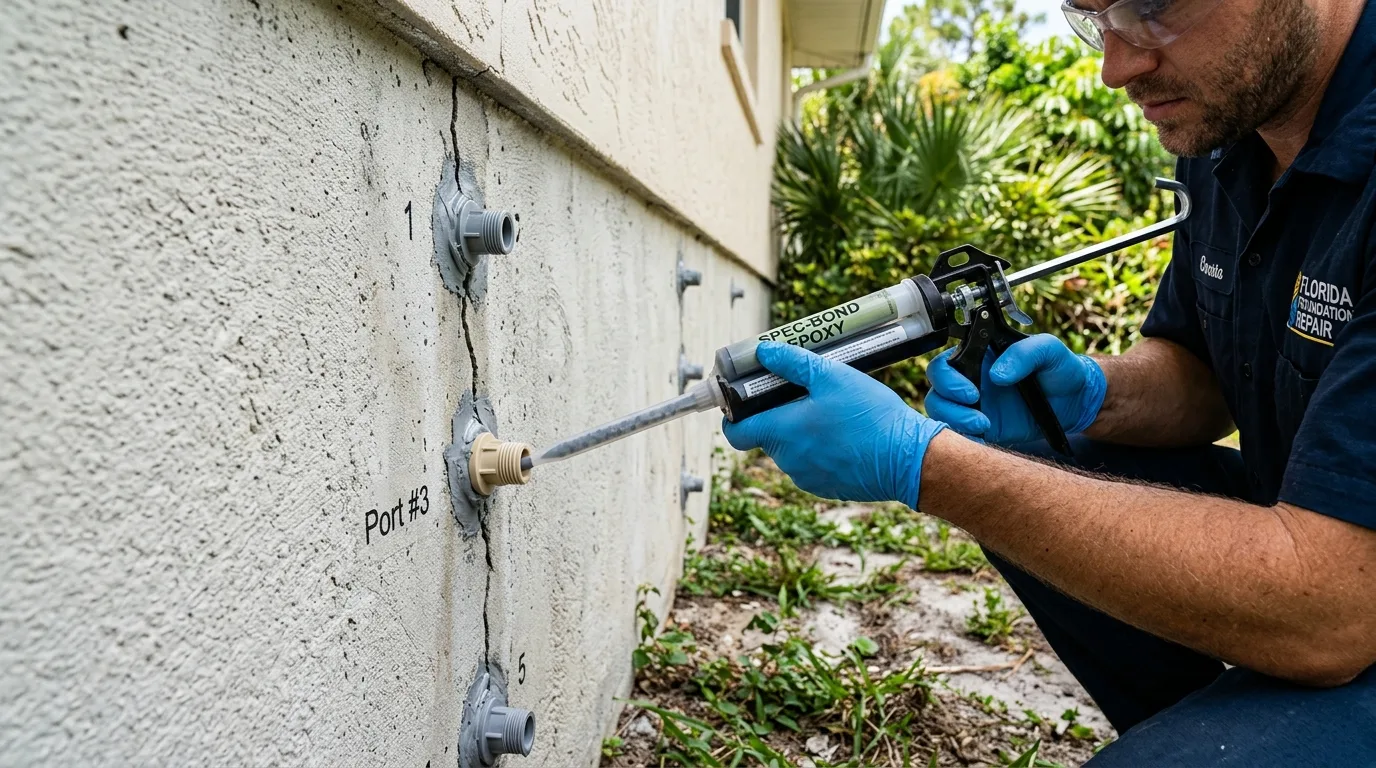
Slab crack repair and sealing: For surface and through-slab cracks without active movement or structural distress, crack injection with polyurethane or epoxy stops water intrusion and stabilizes the crack. This addresses the symptom; drainage correction is still required to address the cause.
Slabjacking (mudjacking): A grout or polyurethane foam mixture is pumped beneath settled slab sections through small drilled holes, lifting them back toward original grade. Effective for sections that have settled uniformly without structural cracking. Requires drainage correction to prevent re-settlement.
Pier installation: For significant differential settlement, steel push piers, concrete piers, or helical piers are installed to transfer the foundation load below the active clay layer to stable bearing soil. This is the appropriate solution when movement has been significant and clay soil stabilization at grade level is insufficient.
Drainage correction: French drains, grading adjustment, and downspout extension are not cosmetic additions — they’re core components of any foundation repair plan in Spring’s clay soil environment. Structural repairs without drainage correction are repaired again within 5–10 years as the moisture imbalance continues to drive movement.
New foundation slabs: When existing slabs are beyond repair or when building additions, new residential foundation slabs in Spring follow engineered specifications: lime stabilization of native clay, compacted base course, minimum 4-inch slab thickness, post-tension cables or rebar as specified, and drainage integration.
Foundation Repair Costs in Spring, TX
Foundation repair costs in Spring vary significantly by repair type and scope:
- Crack injection/surface repair: $200–$800 for localized work
- Mudjacking/foam lifting: $800–$3,000 depending on the number of ports and lift required
- Pier installation: Varies by pier type, depth to stable bearing, and number of piers required — get written estimates
- New foundation slab: $10–$18 per sq ft installed, including lime stabilization and base preparation
- Drainage correction: Highly variable by scope — from $500 for downspout extensions to $5,000+ for comprehensive French drain installation
The cost-effective approach is addressing both structural repair and drainage correction in the same project scope. Structural repair without drainage correction typically needs repeating; drainage correction alone doesn’t fix existing structural damage.
How to Evaluate Foundation Repair Contractors in Spring
Foundation repair is unfortunately an industry with significant high-pressure sales pressure and alarming assessments designed to justify large contracts. The best protection is independent assessment and specific questioning.
Ask every contractor you’re evaluating: “What specifically do you believe is causing the foundation movement, and what does your repair plan do to address that cause?” A qualified contractor will give a specific answer about moisture distribution, soil conditions, and drainage patterns. A contractor who can’t or won’t answer this question specifically is proposing a structural fix without a diagnosis.
Get at least two written assessments from contractors with Spring and Harris County experience before committing. The assessments should agree on the diagnosis even if they propose different repair approaches; if two contractors identify completely different root causes for the same symptoms, a third opinion is warranted.
Frequently Asked Questions
How do I know if my foundation problem is serious or minor?
The distinction that matters most: is the movement active (ongoing) or historical (happened once and stopped)? Signs of active movement include gaps and cracks that have changed size in the last 6–12 months, doors that stick and then release seasonally, and floor slope that has gotten worse over time. Historical damage may look significant visually but requires less urgent intervention. A professional assessment that includes soil moisture monitoring context is the best way to distinguish the two.
Can tree roots cause foundation problems in Spring, TX?
Yes — and it’s more common in Spring’s established neighborhoods than many homeowners realize. Mature oak and pecan trees (common throughout the Spring area) draw significant soil moisture from the clay beneath and around foundations, creating locally dry zones that cause differential settlement. The effect is gradual and worsens as trees mature. If you have large trees within 15–20 feet of your foundation and you’re seeing foundation symptoms, tree root moisture depletion should be part of the diagnostic conversation.
How long does foundation repair last in Texas?
Repairs that address both the structural failure and the underlying drainage/moisture cause last 20–30+ years. Structural repairs that don’t include drainage correction typically require retreatment within 5–10 years as the clay soil continues to move with moisture changes. The key question to ask any foundation contractor is whether their proposal includes drainage correction alongside structural repair.
Spring Concrete Pros — Foundation Assessments Without the Sales Pressure
Free, honest foundation evaluation for your Spring, TX home. We diagnose the cause and repair it right. Call (888) 376-0955.
Related reading: