
Stamped vs. Broom Finish Concrete in Spring, TX: Which Is Right for You?
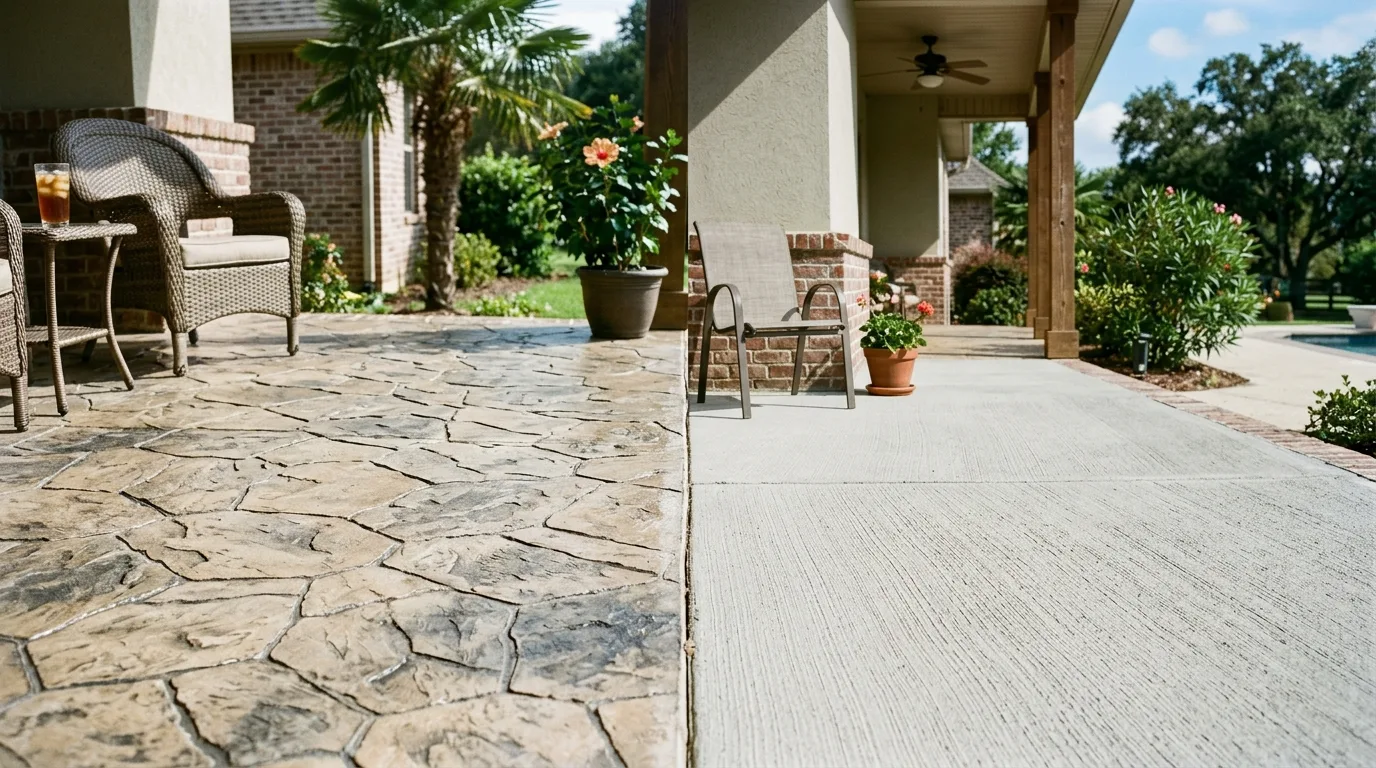
Spring, TX homeowners planning a new driveway or patio face a fundamental choice at the start of every concrete project: standard broom finish or decorative stamped concrete? Both are real concrete. Both last for decades with proper installation. But they perform differently, cost differently, and require different maintenance over time — especially in Spring’s demanding climate.
In this post, we cover: the core differences between broom finish and stamped concrete, side-by-side cost comparison for Spring-area projects, how each finish performs in Houston’s humid subtropical climate, and which one is right for each application.
Not Sure Which Finish Is Right for Your Spring Project?
Spring Concrete Pros walks you through options with samples and pricing at every estimate. Call (888) 376-0955.
What Is Broom Finish Concrete?
Broom finish is the most common concrete surface finish in the United States — and the default for residential driveways, sidewalks, and utilitarian patios. After the concrete is poured, floated, and smoothed, a broom is dragged across the surface before it fully sets, creating a series of fine parallel ridges. These ridges provide traction when the surface is wet and give the concrete a clean, functional appearance.
Broom finish concrete is straightforward to produce, holds up well under vehicle loads, and is easy to maintain. Its main aesthetic limitation is that it looks like concrete — which is fine for a driveway but may feel plain for a patio meant to serve as an outdoor living space.
What Is Stamped Concrete?
Stamped concrete uses the same concrete mix but adds three components to the process: color hardener (pigment integrated into the surface), a release agent (a second color applied before stamping), and rigid pattern stamps pressed into the concrete surface while it’s still plastic. The result is a patterned, two-toned surface that can replicate natural stone, brick, cobblestone, wood planks, or custom geometric designs.
The process requires more skill and timing than broom finish — the stamping window in Spring’s summer heat can be as short as 30–45 minutes — and produces a surface that requires regular sealing to maintain appearance and protect the color.
Cost Comparison in Spring, TX
Here’s the side-by-side cost comparison for Spring-area projects in 2026:
| Finish Type | Cost per Sq Ft | 400 Sq Ft Driveway | 300 Sq Ft Patio |
|---|---|---|---|
| Broom finish | $6–$8 | $2,400–$3,200 | $1,800–$2,400 |
| Exposed aggregate | $8–$12 | $3,200–$4,800 | $2,400–$3,600 |
| Stamped (single pattern) | $9–$12 | $3,600–$4,800 | $2,700–$3,600 |
| Stamped (multi-color) | $12–$15+ | $4,800–$6,000+ | $3,600–$4,500+ |
These ranges reflect installed cost including subgrade prep and first sealer. Harris County clay stabilization adds $0.50–$1.50/sq ft to all options.
The premium for stamped concrete over broom finish is roughly $3–$6 per sq ft — on a 300 sq ft patio, that’s $900–$1,800 more upfront for the decorative finish.
Durability in Spring’s Climate
Both finishes are made of the same concrete and have similar structural durability. The differences are in surface performance:
Broom finish durability:
- Holds up well under vehicle loads — the primary application
- Surface texture is mechanical (grooves), not a coating, so it doesn’t delaminate or peel
- More forgiving of UV exposure than stamped concrete — no color to fade
- Requires sealing every 3–5 years to prevent surface scaling
- Scratches from vehicle tires and debris are less noticeable than on decorative surfaces
Stamped concrete durability:
- Same structural strength as broom finish when properly installed
- Color hardener is integral to the surface layer, not a topcoat — it doesn’t peel
- Release agent layer and sealer provide the visual depth — these do require maintenance
- Spring’s intense UV exposure fades stamped concrete color faster than in cooler climates
- Resealing every 2–3 years is essential to preserve color and pattern definition in the Spring area
- Stamped surfaces show scratches and wear more visibly than broom finish
Maintenance Requirements
This is where the decision gets practical for Spring homeowners:
Broom finish maintenance:
- Seal every 3–5 years (sooner in high-sun areas)
- Clean as needed with mild detergent and pressure washer
- Seal cracks promptly to prevent water intrusion and subbase erosion
- Total maintenance: low — seal periodically, repair cracks promptly
Stamped concrete maintenance:
- Reseal every 2–3 years minimum in Spring’s UV environment
- Strip old sealer and reapply every 5–7 years when the coating system builds up
- Clean with pH-neutral cleaners (acidic cleaners damage the sealer)
- Repair surface delamination if sections of release agent layer lift
- Total maintenance: moderate — color preservation requires consistent attention
Which Finish Is Right for Which Application?
Choose broom finish for:
- Driveways where function and longevity matter more than appearance
- High-traffic areas (alley access, utility pads) where aesthetic premium isn’t warranted
- Budgets where the cost difference is a meaningful constraint
- Homeowners who want low-maintenance concrete they don’t need to think about
Choose stamped concrete for:
- Patios that serve as outdoor living spaces — especially in Spring communities like Gleannloch Farms and Benders Landing where outdoor entertaining is a priority
- Connecting walkways and entry paths where curb appeal matters
- Projects where you want a distinctive look that adds visual value to the property
- Homeowners who are comfortable with the maintenance commitment that stamped concrete requires
Exposed aggregate as the middle ground: Exposed aggregate — where the surface paste is washed away while fresh to reveal the stone aggregate beneath — provides natural texture, excellent traction, and more visual interest than broom finish at a lower cost premium than stamped. It’s a popular choice in Spring for driveways that homeowners want to look better than standard without the full stamped concrete commitment.
Frequently Asked Questions
Does stamped concrete hold up to vehicle traffic in Spring, TX?
Yes — stamped driveways are common and perform well structurally. The concern is appearance: vehicle tires can leave tire marks that show more on decorative surfaces than plain concrete. Properly sealed stamped driveways handle standard passenger vehicle traffic without structural issue. RVs and heavy trucks are better suited to broom finish or exposed aggregate.
Can stamped concrete be repaired if it cracks?
Concrete cracks regardless of finish type. Cracks in stamped concrete are more visible than in broom finish because the surface color makes them stand out. Crack repair on stamped concrete requires color matching — which can be difficult after the surface has weathered. Proper subgrade preparation (clay stabilization in Spring’s soils) significantly reduces the cracking risk.
How often do I really need to reseal stamped concrete in Spring, TX?
In Spring’s UV-intense, humid subtropical environment: every 2 years for surfaces in direct sun, every 2–3 years for shaded surfaces. Skipping resealing causes color fading that’s difficult to reverse without stripping and recoloring the surface — a costly process. Set a reminder and stick to the schedule.
Spring Concrete Pros — All Finish Options Available
We install broom finish, exposed aggregate, and stamped concrete throughout Spring and Harris County. Free estimates with samples. Call (888) 376-0955.
Related reading: