
5 Signs Your Spring, TX Driveway Needs Replacing (Not Just Repairing)
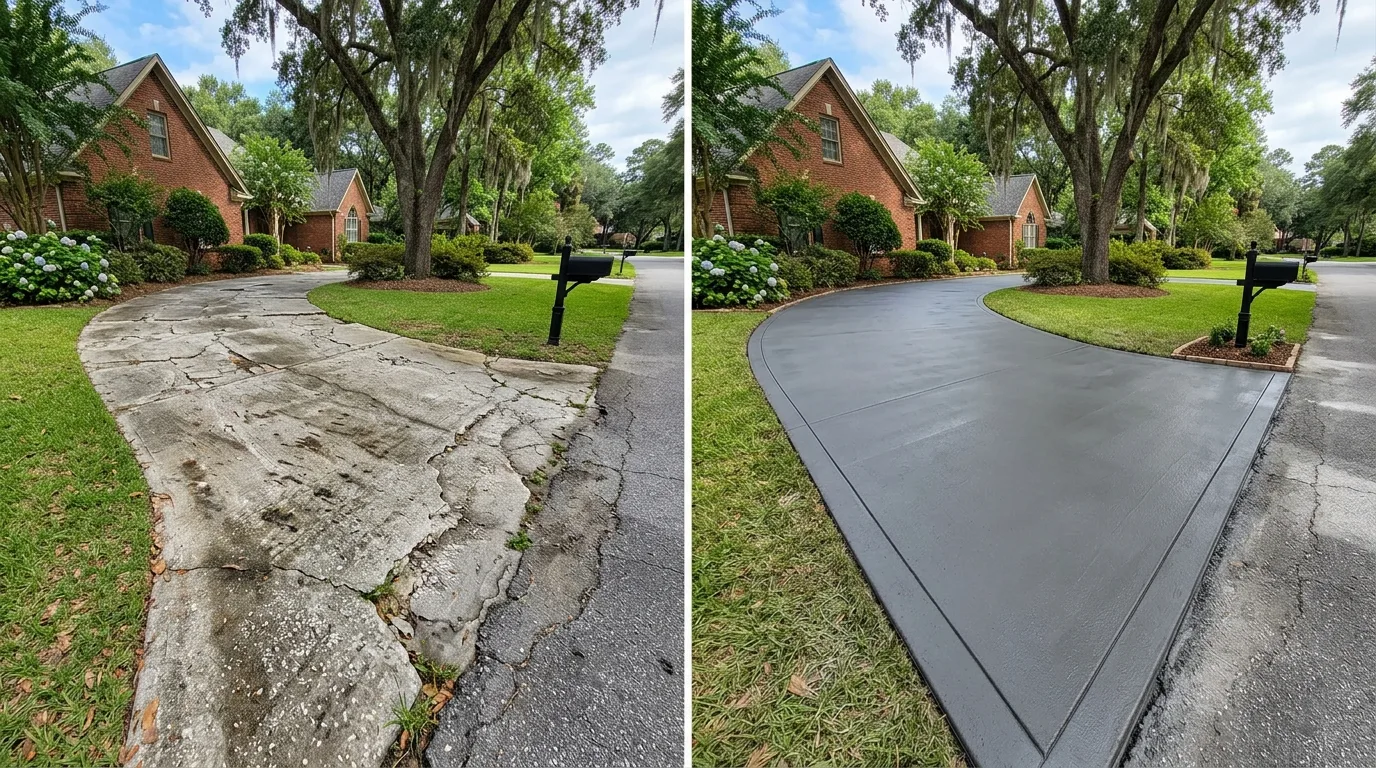
Every Spring, TX homeowner with a concrete driveway faces the same question eventually: is this damage worth repairing, or have I crossed the threshold where replacement makes more sense? The honest answer isn’t always obvious from surface appearance alone — you need to understand what’s happening beneath the concrete to make a sound decision.
In this post, we cover the 5 clearest signs that your Spring-area driveway needs replacement rather than repair, what each sign tells you about the underlying cause, and how Harris County’s clay soil conditions accelerate driveway deterioration in ways that repair can’t fix permanently.
Not Sure Whether to Repair or Replace Your Driveway?
Spring Concrete Pros provides free, honest assessments — no pressure toward replacement when repair will work. Call (888) 376-0955.
Why Repair vs. Replace Is Genuinely Hard to Judge
The challenge with concrete driveway decisions in Spring is that surface appearance understates the structural condition — and Harris County’s clay soils make this worse. A driveway can look moderately cracked on the surface while the subbase beneath has been completely eroded by seasonal water movement. Conversely, a driveway with dramatic surface cracks may have perfectly sound structure and drainage, making it an excellent repair candidate.
The signs below help cut through surface appearance to identify what’s actually happening.
Sign 1: Widespread Cracking That Has Crossed Control Joints
Concrete control joints — the tooled or cut lines you see across most driveways — are intentional weak points designed to control where cracking occurs. When concrete cracks along these joints, it’s doing exactly what it was designed to do. When cracking has spread across control joints, cracking in multiple random locations unrelated to the joints, or full-depth fractures are visible across panels, the slab has exceeded its structural capacity in those areas.
In Spring’s clay soil environment, this pattern typically means the subbase beneath those sections has been compromised — either by clay soil movement, erosion from water intrusion through earlier cracks, or void formation from the shrink-swell cycle. Patching these areas without addressing the subbase buys 2–3 years at best before the new patches fail along the same pattern.
The threshold: If more than 25–30% of the driveway’s surface area shows structural cracking (as opposed to surface hairline cracks), replacement is typically more cost-effective than patching at this scale.
Sign 2: Significant Differential Settlement Between Panels
One section noticeably lower than an adjacent section — creating a step at a control joint — is one of the clearest indicators of subbase void formation. The lower panel has lost support beneath it due to clay soil settlement or void formation; the adjacent panel hasn’t moved. The void is invisible until the next vehicle wheel load causes the unsupported section to rock, sink further, or crack.
In Spring neighborhoods where drainage hasn’t been well-managed — downspouts discharging near the driveway, negative grade sloping toward the concrete — this pattern is common after 10–15 years. The section settling at a control joint can sometimes be mudjacked (foam or grout injected beneath to lift the panel). But if the clay soil is actively moving seasonally and the drainage hasn’t been corrected, mudjacking is a temporary fix that needs repeating every few years.
The threshold: Any panel that has settled more than ¾ inch relative to its neighbor represents a trip hazard and structural failure. If multiple panels show this pattern, the subbase condition throughout the driveway is suspect.
Sign 3: Drainage Is Running Toward the House
This one isn’t immediately obvious as a driveway replacement trigger, but it’s one of the most important. A driveway that drains toward the house rather than away from it is channeling every rain event directly against the foundation — which saturates the clay adjacent to the foundation and initiates the expansion/contraction cycle that damages both the driveway slab and the foundation itself.
Bad drainage on an existing driveway usually means the original installation was poured without adequate slope, or that soil settlement has changed the driveway’s grade over time. Neither repair nor resurfacing can fix drainage without removing the concrete and re-establishing the grade from scratch. That’s effectively a replacement project.
The threshold: If water consistently pools on the driveway surface or runs toward the house after rain rather than away from the garage apron toward the street, drainage correction is required — and correction requires replacement.
Sign 4: Slab Age Over 25 Years Without Maintenance History
An unprotected concrete driveway in Spring’s climate — no sealing, no crack maintenance, 50 inches of annual rainfall — deteriorates at a measurable rate. The UV-intense sun degrades the cement paste at the surface; seasonal clay movement cycles stress the structure repeatedly; water infiltrating through unsealed cracks erodes the base year after year.
By 25 years without maintenance, a Spring-area concrete driveway has typically exhausted its useful life even if it doesn’t look obviously failed. Surface scaling may be present; joints may be open; the aggregate may be starting to show through deteriorated surface paste. At this point, the cost of repairing everything wrong with it approaches the cost of replacement — and replacement gives you a properly prepared subbase with a full 30-year service life ahead of it.
The threshold: Any driveway over 25 years old with no documented maintenance history in Spring’s climate deserves an assessment with replacement as the default option rather than the last resort.
Sign 5: Recurring Failures After Previous Repairs
If your Spring driveway has been patched, filled, or repaired before — and those areas are failing again — the repairs were treating symptoms while the cause continued. In Harris County’s clay soil environment, this almost always means the drainage and subgrade conditions that caused the original failure were never addressed. The patch fails because the clay beneath it is still moving; the crack reopens because the void that opened it is still there.
Recurring failures are the clearest signal that the problem is systemic, not isolated. A new pour with proper subbase preparation — lime stabilization of the clay subgrade, correct drainage grade, and adequate reinforcement — breaks the cycle. Continued patching doesn’t.
The threshold: Two previous repairs to the same location that have both failed is a strong indicator that the underlying cause was never resolved and replacement with proper subgrade treatment is the appropriate next step.
Frequently Asked Questions
How do I tell if I need repair or replacement for a specific crack?
The key indicators are: whether the crack runs along or crosses control joints, whether there’s vertical displacement (one side higher than the other) at the crack, whether water runs through the crack toward the base, and whether the adjacent slab section rocks underfoot. Surface hairline cracks along joints are typically repair candidates. Through-cracks with movement or displacement typically indicate replacement is warranted for that section at minimum.
Can I partially replace a driveway in Spring, TX instead of the whole thing?
Yes — partial replacement (replacing failed sections while leaving sound sections) is a cost-effective option when the failing sections are isolated and the remaining sections have sound structure and drainage. The limitation in Spring’s clay soil environment is that if the subbase throughout the driveway is compromised, partial replacement may not last long as the adjacent sections develop the same failures. We assess which approach makes sense on a case-by-case basis.
How much does driveway replacement cost vs. patching in Spring, TX?
Full replacement runs $6–$12 per sq ft for a typical Spring driveway (depending on finish and base prep). Patching costs $3–$7 per sq ft for the repaired area but doesn’t address structural or drainage causes. On a driveway with 30% failed area and active drainage problems, you’d spend $900–$2,100 patching ($3–$7 × 300 sq ft) without solving the problem — compared to $3,600–$7,200 for a full replacement with proper subbase that lasts 30 years. See our concrete driveway cost guide for full pricing detail.
Free Driveway Assessment in Spring, TX
We'll tell you honestly whether your driveway needs repair or replacement — and why. No pressure either way. Call (888) 376-0955.
Related reading: