
Pouring Concrete in Texas Summer Heat: Tips from Spring Contractors
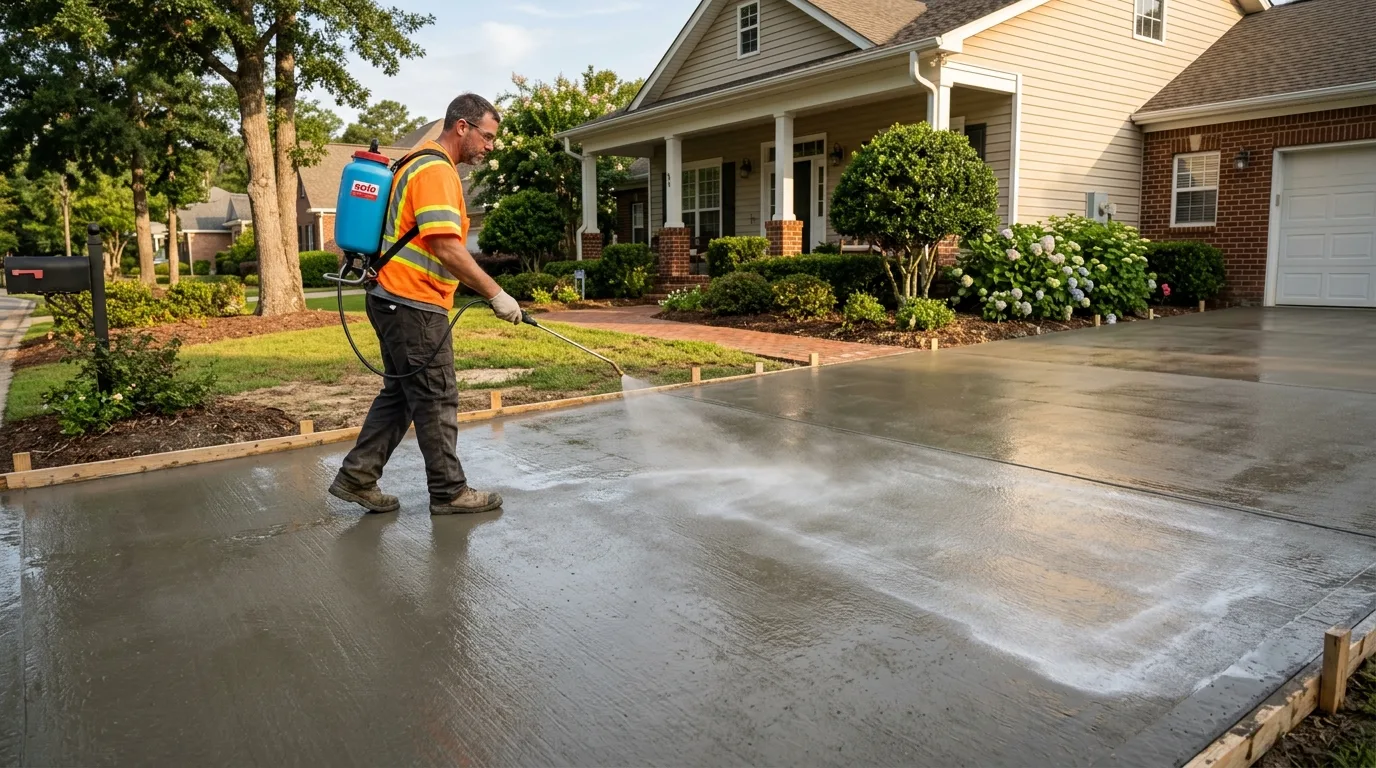
Ask any experienced concrete contractor in Spring, TX how they feel about July pours, and you’ll get a direct answer: possible, but you’d better know what you’re doing. Houston-area summers — with August averages topping 95°F and direct Texas sun raising the slab surface to 130–150°F before anyone pours a drop of concrete — compress the window for proper finishing and stamping to the point where inexperience becomes visible in the finished product.
This guide covers what actually happens to concrete in extreme heat, how experienced Spring contractors manage it, and what homeowners scheduling summer projects should know.
In this post, we cover: why heat is the enemy of fresh concrete, the techniques Spring contractors use to manage summer pours, what questions to ask a contractor scheduling your summer project, and when delaying to fall is the smarter choice.
Planning a Summer Concrete Project in Spring, TX?
Spring Concrete Pros manages Texas summer pours with proven techniques. Call (888) 376-0955 for scheduling and a free estimate.
What Heat Actually Does to Fresh Concrete
Concrete doesn’t dry — it hydrates. The cement particles react chemically with water in a process that generates its own heat (the heat of hydration). The chemical reaction works best between 50°F and 90°F. When ambient and surface temperatures push above 90°F — standard summer conditions throughout the Spring area and broader Harris County — several problems compound:
Accelerated set time: High temperatures speed up cement hydration, which shortens the window between placing concrete and when it’s too stiff to work. A standard concrete mix that gives a finisher 45–60 minutes to work on a 75°F day may give only 20–30 minutes on a 95°F afternoon. For stamped concrete, this can be a critical constraint — pattern stamps must be applied while the concrete is still plastic.
Plastic shrinkage cracking: When the evaporation rate from the concrete surface exceeds the rate at which bleed water rises to the surface, the surface dries faster than the interior. The differential drying creates tension in the fresh concrete that causes surface cracks — sometimes appearing within 30–60 minutes of placement. These cracks are irreversible once formed and significantly affect surface appearance and durability.
The formula that determines whether plastic shrinkage cracking will occur depends on air temperature, concrete temperature, relative humidity, and wind speed. In Spring’s summer conditions — 95°F air, 70–80% humidity, occasional afternoon breeze — the conditions for plastic shrinkage cracking exist regularly, but humidity mitigates the risk compared to drier Western climates. The key variable is wind speed: even 5 mph wind in 95°F heat dramatically increases evaporation rate.
Reduced long-term strength: Concrete that cures too rapidly in heat doesn’t achieve its design compressive strength. A slab cured properly reaches 4,000 PSI at 28 days; a slab that dries too fast in summer heat may reach only 3,200–3,400 PSI — a significant reduction that affects long-term durability and load capacity.
How Spring Contractors Manage Summer Pours
Experienced concrete contractors in Spring haven’t stopped doing summer work — they’ve adapted their process to manage the heat:
Early morning pours: Scheduling the concrete delivery for 6–7 AM means the slab is placed, floated, and well into the finishing process before the worst midday heat arrives. Placing concrete when air and slab temperatures are in the 75–85°F range rather than 95°F+ gives the crew more working time and better evaporation management. For stamped concrete projects, this is especially critical — the stamping window is significantly longer at 7 AM than at noon.
Precooling the subgrade: Wetting the forms and subgrade before the pour reduces the temperature differential between the concrete and the surfaces it contacts. This slows the rate at which the concrete loses heat and extends the working window slightly.
Evaporation retardants: A monomolecular film retardant (products like Confilm or equivalent) is sprayed on the concrete surface between screeding and final finishing passes. It creates a thin film that slows surface evaporation without affecting the concrete chemistry. This is standard practice for summer work in the Spring area and gives the crew more working time.
Adjusting mix design: Retarding admixtures added to the concrete mix slow the setting rate, compensating for heat-accelerated hydration. The retarder is calibrated to the expected temperature — more retarder on a 100°F day, less on a 90°F day.
Shading and wind management: For smaller projects, temporary shade structures over the pour can reduce the surface temperature by 15–20°F — a meaningful difference in summer conditions. Identifying and blocking prevailing breeze direction prevents wind from dramatically increasing the evaporation rate at the surface.
Wet curing immediately after finishing: The single most important summer curing practice is applying wet burlap, curing blankets, or curing compound immediately after the surface is finished. Curing in summer requires 7 days of maintained moisture — longer than the 5–7 days standard in cooler conditions.
What Homeowners Should Ask Before Scheduling a Summer Pour
If you’re scheduling concrete work in June–August, ask your Spring contractor specifically:
- “What time are you planning to schedule the concrete delivery?” (If the answer is 10am or later for a major pour, that’s a problem.)
- “Will you be using an evaporation retardant?” (Yes should be the answer for any summer surface work.)
- “What curing method will you use after finishing?” (Wet curing for 7 days minimum.)
- “What’s your plan if conditions on pour day are worse than expected?” (A qualified contractor has a defined abort/reschedule threshold based on wind speed and temperature.)
A contractor who doesn’t have specific answers to these questions hasn’t thought through the summer management requirements. This isn’t nitpicking — these are the factors that determine whether your summer pour produces a quality slab or one with surface defects that appear within days.
When Delaying to Fall Makes More Sense
Sometimes the best summer concrete advice is: wait. If your project involves:
Stamped concrete: Summer stamping is manageable with an experienced crew but has a significantly narrower margin for error than fall work. If your stamped project is decorative-critical (a high-visibility patio or entrance), scheduling for September–October is lower risk.
Large pours: Large slabs (400+ sq ft) are harder to manage in summer because more surface area is exposed to evaporation simultaneously. The crew must work faster across a larger area in a shorter time window.
No project urgency: If there’s no reason you need concrete in July — you just want to get it done — fall scheduling gets you better curing conditions, potentially better contractor availability pricing, and less complexity overall.
The Spring concrete season runs year-round with proper management. Fall is simply the season where concrete work is most forgiving for both the contractor and the homeowner.
Frequently Asked Questions
What is the maximum temperature for pouring concrete in Texas?
The American Concrete Institute defines hot weather concrete as placement conditions where air temperature exceeds 90°F, concrete temperature exceeds 95°F, relative humidity is below 50%, or wind speed exceeds 15 mph. Any of these conditions alone or in combination triggers hot weather concrete practices. In Spring, TX summer, most days from late June through August meet one or more of these thresholds. Concrete can be placed successfully in these conditions with the management techniques described above.
Can stamped concrete be poured in the summer in Spring, TX?
Yes — experienced stamped concrete contractors work through Spring-area summers regularly. The key is crew experience with the narrow stamping window and early morning scheduling. A crew that has done hundreds of stamped projects in Houston’s summer knows exactly how to pace the work. A less experienced crew attempting summer stamped concrete for the first time is higher risk. Ask for summer stamped concrete references specifically when evaluating contractors.
Does summer heat affect the strength of my concrete driveway?
It can, if curing is inadequate. Rapid moisture loss during curing reduces achieved strength below design specification. Properly executed wet curing for 7 days in summer produces concrete that achieves its design strength reliably. This is why the curing question — “What method will you use?” — is important to ask. See our best time to pour concrete guide for full seasonal context.
Spring Concrete Pros — Experienced Texas Summer Concrete Work
We manage summer pours with proper technique so your Spring concrete project turns out right regardless of the season. Call (888) 376-0955.
Related reading: