
How to Maintain Your Concrete Patio in Houston's Humid Climate
A well-installed concrete patio in Spring, TX can last 25–40 years — but “can last” and “will last” depend on how it’s maintained. Houston’s humid subtropical climate creates specific maintenance challenges: intense UV exposure that breaks down unsealed concrete surfaces faster than in cooler climates, ~50 inches of annual rainfall that tests drainage and moisture management year-round, and occasional cold snaps that stress improperly sealed joints. This guide gives Spring-area homeowners a practical maintenance schedule and explains why each step matters in this climate.
In this post, we cover: the sealing schedule that actually works in Houston’s climate, cleaning methods for concrete without damaging the surface, how to handle common patio problems before they escalate, and the one maintenance step that matters more than anything else.
Need Your Spring Patio Sealed or Repaired?
Spring Concrete Pros handles concrete maintenance and repair throughout Harris County. Call (888) 376-0955.
Why Concrete Maintenance in Houston Is Different
The maintenance advice you’ll find in generic concrete care guides assumes a temperate climate with moderate UV exposure and seasonal freeze-thaw cycles. Spring, TX has none of that — it has its own set of conditions that require a locally calibrated approach:
UV intensity: Spring’s latitude and year-round sun exposure subjects concrete surfaces to more UV radiation than most of the country. UV breaks down the cement paste at the surface, causing scaling and discoloration on unsealed concrete. For stamped concrete specifically, UV fades color hardeners noticeably within 2–3 years of unsealed exposure.
Rainfall: 50 inches annually, with some of it delivered in intense events (Spring receives several 2–4-inch single-day events per year). This level of rainfall tests drainage constantly and means unsealed concrete is frequently saturated — accelerating surface scaling and subsurface erosion.
Heat: Spring’s summer heat isn’t a freeze-thaw stressor (the way northern climates damage concrete), but it does drive significant thermal expansion that stresses joints and sealers. A properly sealed joint handles this; a poorly sealed or unfilled joint allows water intrusion that worsens with each thermal cycle.
Clay soil: The Beaumont clay beneath most Spring patios continues to respond to moisture variation throughout the patio’s life. Maintenance that keeps drainage functioning correctly reduces the clay movement cycle that eventually cracks slabs.
The Maintenance Step That Matters Most: Sealing
If you do one thing to extend your Spring patio’s life, seal it on a proper schedule. Sealer is not cosmetic on a Houston-area patio — it’s a functional barrier against UV degradation, surface moisture infiltration, and the scaling cycle that leaves concrete looking weathered and pitted.
Recommended sealing schedule for Spring, TX:
For plain/broom-finish concrete: Seal every 3 years. Spring’s UV and rainfall make 5-year intervals (common in cooler climates) too long — the surface shows deterioration by year 4 without resealing.
For stamped concrete: Seal every 2 years for sun-exposed surfaces, every 2–3 years for shaded patios. The color hardener layer is more UV-sensitive than plain concrete and shows degradation faster without sealer protection.
For exposed aggregate: Seal every 3 years. The aggregate texture itself is durable, but the cement paste between aggregate pieces is as vulnerable as any concrete surface.
When to reseal regardless of schedule:
- Water no longer beads on the surface (it soaks in immediately instead)
- Surface appears dull, powdery, or shows white chalking
- Stamped concrete color has visibly faded in high-sun areas
- You can see surface scaling beginning (small chips or flaking at the surface)
Sealer types for Spring’s climate:
Penetrating sealers (silane, siloxane, or silane-siloxane blends) penetrate the concrete and react chemically to block water infiltration without changing the surface appearance. These are excellent for plain concrete and provide good UV and moisture protection without the yellowing that some film-forming sealers develop in heat.
Film-forming sealers (acrylic, epoxy, polyurethane) create a protective coating on the surface that provides color enhancement and UV protection. These are standard for stamped concrete where maintaining color vibrancy is the goal. They require stripping and reapplication every 5–7 years when the coating builds up.
Cleaning: What Works and What Damages Concrete
Do:
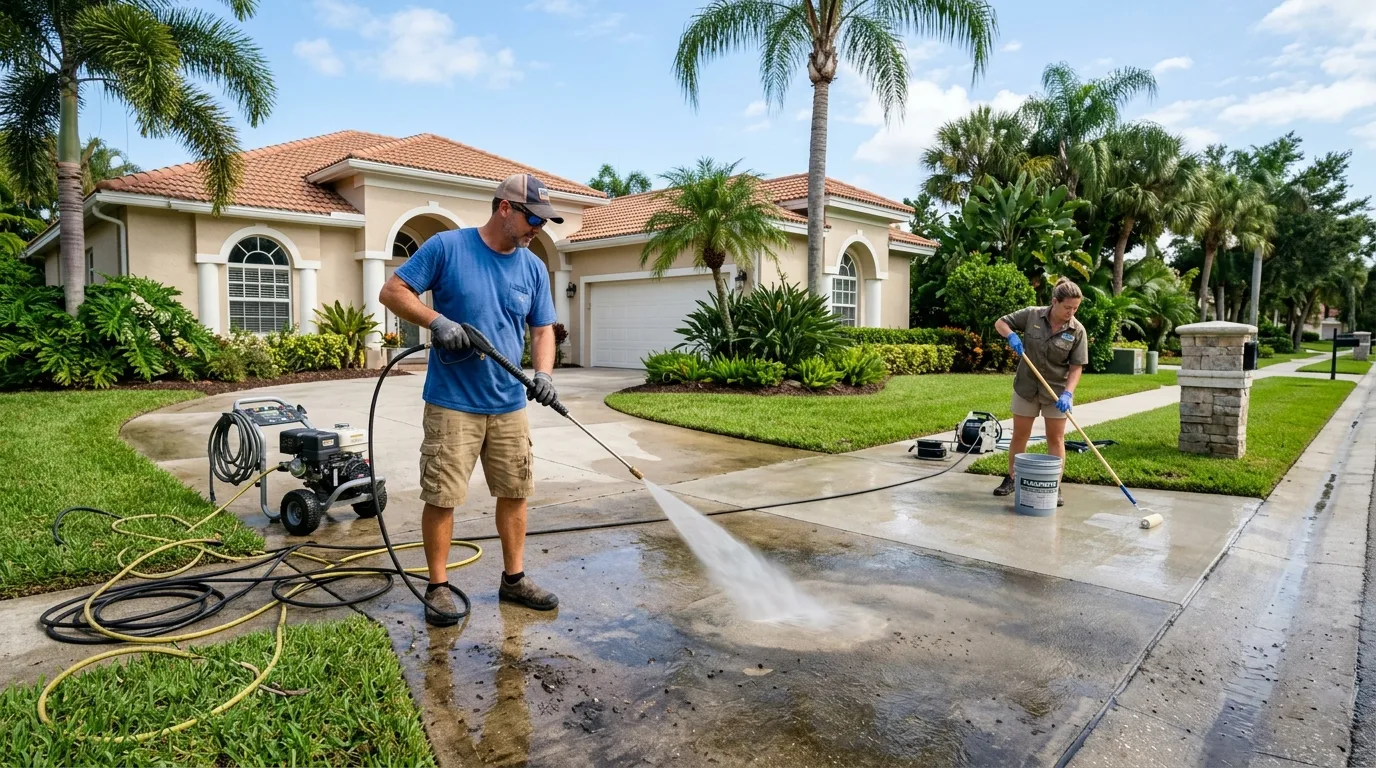
- Use a pressure washer at 2,000–2,500 PSI for periodic deep cleaning. This removes mold, mildew, dirt, and surface staining without damaging the concrete or sealer.
- Use a mild pH-neutral detergent for stubborn stains before pressure washing.
- Clean mold and algae promptly — Spring’s humidity encourages growth on shaded concrete surfaces that aren’t regularly cleaned or resealed.
Don’t:
- Use acidic cleaners (vinegar, CLR, muriatic acid) on sealed concrete. Acids etch the sealer and can damage the cement surface. Even “natural” acid cleaners damage sealed decorative concrete.
- Pressure wash at over 3,000 PSI — this can etch the surface and remove sealers.
- Use wire brushes or metal scrapers on stamped or decorative concrete surfaces.
For algae and mold (common on shaded Spring patios due to humidity), a diluted bleach solution (1 part bleach, 4 parts water) is effective. Apply, let sit 10 minutes, scrub with a stiff nylon brush, rinse thoroughly. Bleach-based cleaners can lighten stamped concrete color over time — use sparingly and reseal promptly after cleaning.
Crack Maintenance: Catch Early, Cost Little
The rule with concrete cracks in Spring is simple: seal them before they grow. A hairline crack costs $15 in caulk and 20 minutes to seal. The same crack at ¼ inch with eroded edges and water running through it costs $150–$400 to fill professionally. The same location at ½ inch with void formation beneath it is a structural repair conversation.
Check your patio’s control joints and any existing cracks annually — a 10-minute walk-around after spring and fall rainy seasons. Look specifically for:
Joint filler deterioration: The flexible polyurethane or backer rod-plus-sealant in control joints wears over time. When it pulls away from the joint edges or breaks, replace it before water has a free channel to the subbase.
New cracks: Any crack that wasn’t there last year deserves attention. Note whether it’s at a control joint (expected) or random (more concerning), and whether there’s any vertical displacement between the two sides (indicates structural movement, not just surface tension cracking).
Edge lifting: Where the patio meets adjacent surfaces (house wall, landscaping edge), watch for the concrete lifting slightly off adjacent grade. This indicates subgrade movement or water undercutting the edge.
Drainage Maintenance: Keeping Water Moving
Spring’s high annual rainfall means drainage around your patio needs to stay functional year-round. Specifically:
Keep drainage channels clear: If your patio has designed drainage channels or a swale at the perimeter, keep them free of leaf debris and sediment that can block water flow.
Watch for grade change: Over time, soil around a patio can shift, changing the drainage slope relative to the concrete. A patio that drained correctly at installation may develop ponding areas as adjacent soil settles or erodes. Regrading the perimeter with topsoil is a simple fix that prevents the ponding-to-clay-saturation cycle.
Gutters and downspouts: Make sure downspouts are directed away from the patio area. A downspout discharging adjacent to the patio perimeter delivers concentrated water directly to the clay subbase — the worst possible scenario for long-term patio performance.
Frequently Asked Questions
How often should I seal my concrete patio in Spring, TX?
Every 2–3 years for stamped concrete in sun-exposed areas; every 3 years for plain concrete. The easy test: pour a small amount of water on the surface. If it beads up, the sealer is still working. If it absorbs immediately, it’s time to reseal. Spring’s UV intensity makes longer intervals common in cooler climates impractical here.
What’s the best sealer for a Houston-area concrete patio?
For stamped or decorative concrete: a UV-stable acrylic or polyurethane film-forming sealer provides the color enhancement and UV protection the decorative surface needs. For plain concrete: a penetrating silane-siloxane sealer provides excellent moisture and UV protection without changing the surface appearance. Both types are widely available and professionally applied. We recommend professional application for full coverage and correct film thickness.
Can I seal my patio myself or should I hire a professional?
DIY sealing is feasible for plain concrete patios using roller or sprayer application. Stamped concrete and large patios benefit from professional application because even coverage and correct film thickness matter for both appearance and protection. Improper application (too thick, wrong product for the surface type) can cause peeling and sealer failure that requires stripping and reapplication.
Spring Concrete Pros — Patio Sealing and Maintenance Services
We handle patio sealing, crack repair, and surface restoration throughout Spring and Harris County. Call (888) 376-0955.
Related reading: